Pages

Saturday, May 09, 2026

Wes Anderson's Cinema

Spotlight on Wes Anderson’s films & books

Films (in order of release):

1. Bottle Rocket (1996)

2. Rushmore (1998)

3. The Royal Tenenbaums (2001)

4. The Life Aquatic with Steve Zissou (2004)

5. The Darjeeling Limited (2007)

6. Fantastic Mr. Fox (2009)

7. Moonrise Kingdom (2012)

8. The Grand Budapest Hotel (2014)

9. Isle of Dogs (2018)

10. The French Dispatch (2021)

11. Asteroid City (2023)

12. The Phoenician Scheme (2025)

Note: the collection of Short films The Wonderful Story of Henry Sugar and Three More (2024) are not considered as part of this spotlight.

Books:

Wes Anderson: The Archives (2025)

Accidentally Wes Anderson, Vol. 1 (2020)

Accidentally Wes Anderson, Vol. 2 (2024)

Wes Anderson’s unique style

Show a frame of a Wes Anderson film to majority of movie fans and they would be able to instantly recognize it as that of a Wes Anderson. This is true even of non-cinephiles or non avid film-lovers.

A few standout elements:

The Grand Budapest Hotel, courtesy Criterion

Distinct visual palette: pastel, muted green or yellow palettes are telltale signs that you are looking at a Wes Anderson film.

The Darjeeling Limited, courtesy Criterion

Precise framing: the highly controlled visual frames of a Wes Anderson film standout with characters and objects in the center of a frame. This distinctive look is instantly recognizable especially when coupled with the character’s deadpan or expressionless face.

The Grand Budapest Hotel, courtesy Criterion

Stylish production design: the sets, costumes in a Wes Anderson film are just gorgeous to look at and evoke story-book imagery or they are playful variations of periodic pieces.
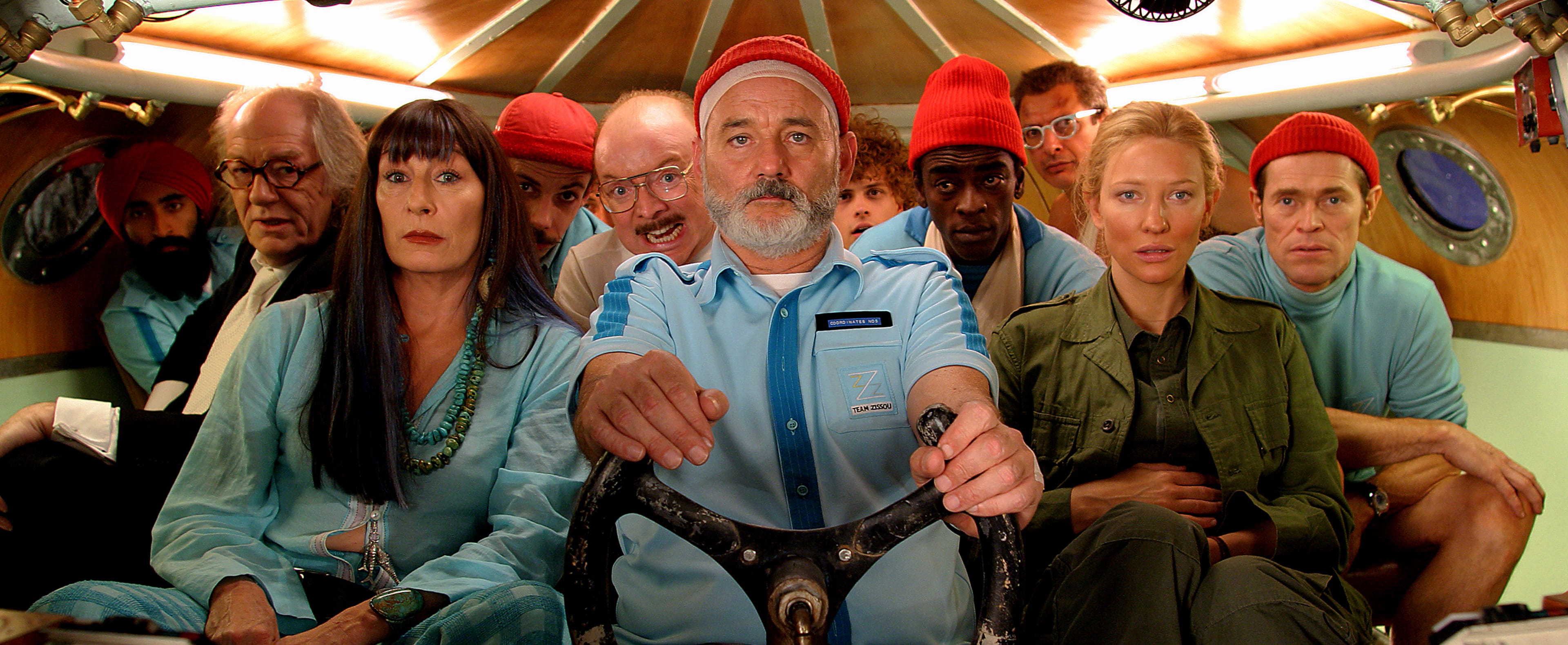
The Life Aquatic with Steve Zissou, courtesy Criterion

Interconnected stories: Wes Anderson’s films, starting with his third feature The Royal Tenenbaums, feature multiple interconnected stories with a large ensemble of popular recognizable actors.

The visual elements in Wes Anderson’s film have even led to the Accidentally Wes Anderson project, including two book collections, where photographers take pictures of real-life locations that look like they could be from a Wes Anderson film. Wes Anderson penned a forward for Vol.2 and mentioned that he had been to only 1 place highlighted in the book. Some of the locations have existed for thousands of years. That indicates the range of Wes Anderson’s influences for his films or that we have all been living in a Wes Anderson world.

Of course, Wes Anderson’s visual style wasn’t always recognizable especially in his first two films. His cinema can be broken down into three phases.

Wes Anderson 1.0: quirky comedies, fiercely independent

Films in this phase: Bottle Rocket (1996), Rushmore (1998)

Wes Anderson’s debut feature Bottle Rocket is also the acting debut of brothers Owen and Luke Wilson, a collaboration that have enriched many of Anderson’s features. Anderson co-wrote the script with Owen Wilson. The film’s visual style is more in keeping with American indie cinema of the 1990s but the quirky humour is present.

Rushmore starts the first steps towards the contemporary Wes Anderson style with Jason Schwartzman (playing the character of Max Fisher) starting his collaboration with Wes Anderson. The film contains many shots which depict collection of unique objects, as aspect that is part and parcel of his subsequent films. The story flows like a conventional film although the depiction of Max in the center of the frame is the start of Anderson’s future framing style. The humour isn’t deadpan yet but a variation of quirky.

Wes Anderson 2.0: visual style emerges along with larger ensemble

Films in this phase: The Royal Tenenbaums (2001), The Life Aquatic with Steve Zissou (2004), The Darjeeling Limited (2007), Fantastic Mr. Fox (2009), Moonrise Kingdom (2012), The Grand Budapest Hotel (2014), Isle of Dogs (2018)

The Royal Tenenbaums is the first film of what we know recognize as Wes Anderon’s style: stylish visual palette, deadpan humour, presence of interconnected stories.

The films in this phase depict a narrative arc via the lens of Wes Anderson’s style. That means, there is still focus on the story and characters while Anderson’s style enhances the material or acts as garnish. The locations still manage to shine through such as the Indian landscape in The Darjeeling Limited.

Wes Anderson 3.0: film takes place in Wes Anderson land

Films in this phase: The French Dispatch (2021), Asteroid City (2023), The Phoenician Scheme (2025)

The three features in this phase stand-out as they don't boast a coherent narrative arc. Instead, the films are a series of interconnected vignettes where the individual pieces, no matter how brilliant, don’t add up to a whole. The locations for the films don’t matter as everything takes place in a Wes Anderson designed studio, with each frame tightly controlled. These 3 films perfectly conform to the Wes Anderson style of cinema at the expense of a story or a narrative arc. As a result, the form is more important than the content. That means, the purpose of the jokes, various segments doesn’t serve the overall story but is merely there to align with the overall Wes Anderson style.

The French Dispatch is unwatchable at times, Asteroid City is only marginally better and The Phoenician Scheme shows signs of life only due to the presence of Benicio del Toro whose deadpan expressions highlight that Wes Anderson can fit any actor in his cinematic style.

Ranking Wes Anderson’s films in order of preference:

1. Fantastic Mr. Fox (2009)

A delightful film which is enhanced by Wes Anderson’s style. George Clooney’s voice truly makes the Mr. Fox character a joy to witness.

2. The Grand Budapest Hotel (2014)

Peak Wes Anderson 2.0 style. A film which showed how his style combined with a location can work wonders.

3. The Royal Tenenbaums (2001)

The first introduction to the contemporary Wes Anderson style is a charming, witty film.

4. The Isle of Dogs (2018)

Playful, fun and in a way foreshadows the chaos that the pandemic introduced in 2020.

5. The Darjeeling Limited (2012)

This film shows how actual foreign locations can work within the framework of Wes Anderson’s cinema. The bright colours of India were always going to pop but here they sing. High profile cameos are now expected in Wes Anderson’s films and this film contains one such cameo of Irrfan Khan.

6. Rushmore (1998)

7. Bottle Rocket (1996)

8. The Life Aquatic with Steve Zissou (2004)

9. The Phoenician Scheme (2025)

10. Moonrise Kingdom (2012)

11. Asteroid City (2023)

12. The French Dispatch (2021)

Essential reading

Two Adam Nayman articles perfectly describe the recent Wes Anderson cinema.

Wes Anderson’s The Phoenician Scheme Embraces the Modest Pleasures | The New Republic

Welcome Back to Wes World - The Ringer

Wednesday, May 06, 2026

The Films of Oliver Laxe

Spotlight on Oliver Laxe’s films:

You All Are Captains (2010)

Mimosas (2016)

Fire Will Come (2019)

Sirat (2025)

Plus, additional note on Ben Rivers’ The Sky Trembles and the Earth is Afraid and the Two Eyes Are Not Brothers (2015)

I am happy to say that I was there from the start to witness Oliver Laxe’s film trajectory. His debut feature, You All Are Captains, was part of our film festival’s Mavericks program, a spotlight to showcase new promising directors. Safe to say, our festival got Laxe’s selection right. He indeed has gone to great acclaim since his debut feature.

There are a few common elements/themes that emerge from all four features, including Ben River’s The Sky Trembles:

Landscape as character: Landscape plays a big part in all of Laxe’s films with the rugged terrain of Morocco in 3 of his features plus Ben Rivers’ The Sky Trembles. The exception of a Moroccan location is Laxe’s Fire Will Come but in that film, the landscape of Spain is front and centre with its depiction of the Galician forests.

Spiritual and Mysticism: Spiritualism and mysticism permeate in Oliver Laxe’s films with characters undertaking life-changing journeys and grappling with themes of guilt, death, redemption.

Immersive and contemplative cinema: Laxe’s films offer an immersive experience with the thoughtful combination of camera angles and usage of music. The shots aren’t rushed, thereby allowing one to soak in the atmosphere while contemplating on the character’s fate and choices.

You All Are Captains (2010)

Oliver Laxe’s impressive award winning black and white film demonstrates that even an improvised film needs a structure to make the work engaging. The film's first 20 minutes feature a filmmaker teaching school kids how to use a camera. The filmmaker has no script or goal in mind and a result, frustrates his students who are puzzled by the filmmaker's motives. After the kids complain, the filmmaker is replaced with another director who gives a structure thereby letting the film's brilliance shine through. The ending of the film in color puts the whole work into perspective including the first 20 minutes. Laxe brilliantly announced himself with this bold assured debut.

The Sky Trembles and the Earth is Afraid and the Two Eyes Are Not Brothers (2015, Ben Rivers)

This film’s long title, multi-layered structure and core story draws inspiration from Paul Bowles’ writing. The structure of the film is a nod to what Bowles managed in ‘A Hundred Camels in the Courtyard’ where Bowles found a common thread to link 4 completely different stories together. In The Sky Trembles, Ben Rivers has constructed a film which links together multiple works including a short story, a short film, some documentary footage and an art installation. All these works are seamlessly stitched together in a linear manner.

Rivers has managed this by alternating one aspect of Paul Bowles’ short story ‘A Distant Episode’. In the short story, the main character is a professor. In the film, the main character is a film director. This change allows Ben Rivers to find a common thread to link the different elements. This is because at the start of The Sky Trembles, we see the filmmaker Oliver Laxe scouting for locations in Morocco and attempting to complete a gruelling film shoot. The scenes we see are actual footage from Laxe's second feature Mimosas. And then at some point in The Sky Trembles, Oliver Laxe stops shooting his film and steps into Paul Bowles story. What then follows is a series of remarkable events.

Mimosas (2016)

The Mimosas appetizer in Ben Rivers’ The Sky Trembles was promising which is why it is an absolute pleasure to discover that Laxe’s second feature Mimosas delivers a scrumptious cinematic buffet. In fact, Mimosas contains the full depiction of Laxe’s cinematic style (landscape, mysticism, contemplation) and one can draw a direct line from Mimosas to Sirat.

Sirat (2025)

Mimosas got noticed on the film festival circuit but you would have been hard pressed to find it on any end of the year list or part of general film conversation. The same cannot be said of Sirat, which has featured prominently in best of the year lists. The success of Sirat shows how one can retool their film for a wider audience. The Mimosas to Sirat repackaging echoes that of Albert Serra who took the core of his earlier study of diplomats and powerful people and repurposed it in a more contemporary setting for Pacification which ended up being his most accessible and widely distributed film. In a similar manner, Laxe has taken the essence and core of Mimosas and repurposed it in Sirat.

Mimosas features a spiritual journey where death hovers over it characters, both literally and metaphorically. Death is also omnipresent in Sirat but Laxe trades away the silence in Mimosas for techno music (EDM, rave music). The subtle spirituality of Mimosas gives way to the on the nose scenarios of Sirat’s final third act. Both Mimosas and Sirat end in a similar manner, where characters trade up their traveling method. In Mimosas, the foot and horse journey gives way to cars in the end, while in Sirat the cars/vans give way to train. The finale of each film shows that the characters are defeated by the Moroccan landscape and their mode of transportation is a respite, away from the landscape which they may not have conquered physically but certainly scaled in a spiritual manner. You can be sure that the characters in both these films emerge from the landscape transformed.

Fire Will Come (2019)

There is a transformation in Fire Will Come and the film is a trial by fire for its main character, Amador (Amador Arias), who is released from jail for suspected arson and returns home to live with his mother. His crimes are not forgiven and the locals are still suspicious of him. Therefore, it isn’t surprising that when a fire breaks out, they suspect him. However, Amador is determined to cleanse his soul and fight his inner demons.

The film’s rural setting and suspicious neighbours reminds of Rodrigo Sorogoyen’s riveting film The Beasts (2022). However, the differing approaches of both films show overall intent of the director. The Beasts shows what unfolds when simmering inner frustrations are allowed to erupt leading to violence. In Fire Will Come, Amador is suffering as well but his struggle is internalized. The fire in the film is also symbolic of his attempt at burning away his past and being reborn, in a similar manner to how fires help shape a forest and allow it to grow back healthier.

Ranking Oliver Laxe’s films in order of preference:

1. Mimosas (2016)

The best of all four of Oliver Laxe’s films and one that highlights his auteur style the best.

2. Sirat (2025)

The most successful of Laxe’s films to date and is a case study of how to take spiritual themes of a more artistic film such as Mimosas and repurpose for a more accessible film.

3. Fire Will Come (2019)

4. You All Are Captains (2010)