Pages

Showing posts with label Wes Anderson. Show all posts

Saturday, May 09, 2026

Wes Anderson's Cinema

Spotlight on Wes Anderson’s films & books

Films (in order of release):

1. Bottle Rocket (1996)

2. Rushmore (1998)

3. The Royal Tenenbaums (2001)

4. The Life Aquatic with Steve Zissou (2004)

5. The Darjeeling Limited (2007)

6. Fantastic Mr. Fox (2009)

7. Moonrise Kingdom (2012)

8. The Grand Budapest Hotel (2014)

9. Isle of Dogs (2018)

10. The French Dispatch (2021)

11. Asteroid City (2023)

12. The Phoenician Scheme (2025)

Note: the collection of Short films The Wonderful Story of Henry Sugar and Three More (2024) are not considered as part of this spotlight.

Books:

Wes Anderson: The Archives (2025)

Accidentally Wes Anderson, Vol. 1 (2020)

Accidentally Wes Anderson, Vol. 2 (2024)

Wes Anderson’s unique style

Show a frame of a Wes Anderson film to majority of movie fans and they would be able to instantly recognize it as that of a Wes Anderson. This is true even of non-cinephiles or non avid film-lovers.

A few standout elements:

The Grand Budapest Hotel, courtesy Criterion

Distinct visual palette: pastel, muted green or yellow palettes are telltale signs that you are looking at a Wes Anderson film.

The Darjeeling Limited, courtesy Criterion

Precise framing: the highly controlled visual frames of a Wes Anderson film standout with characters and objects in the center of a frame. This distinctive look is instantly recognizable especially when coupled with the character’s deadpan or expressionless face.

The Grand Budapest Hotel, courtesy Criterion

Stylish production design: the sets, costumes in a Wes Anderson film are just gorgeous to look at and evoke story-book imagery or they are playful variations of periodic pieces.
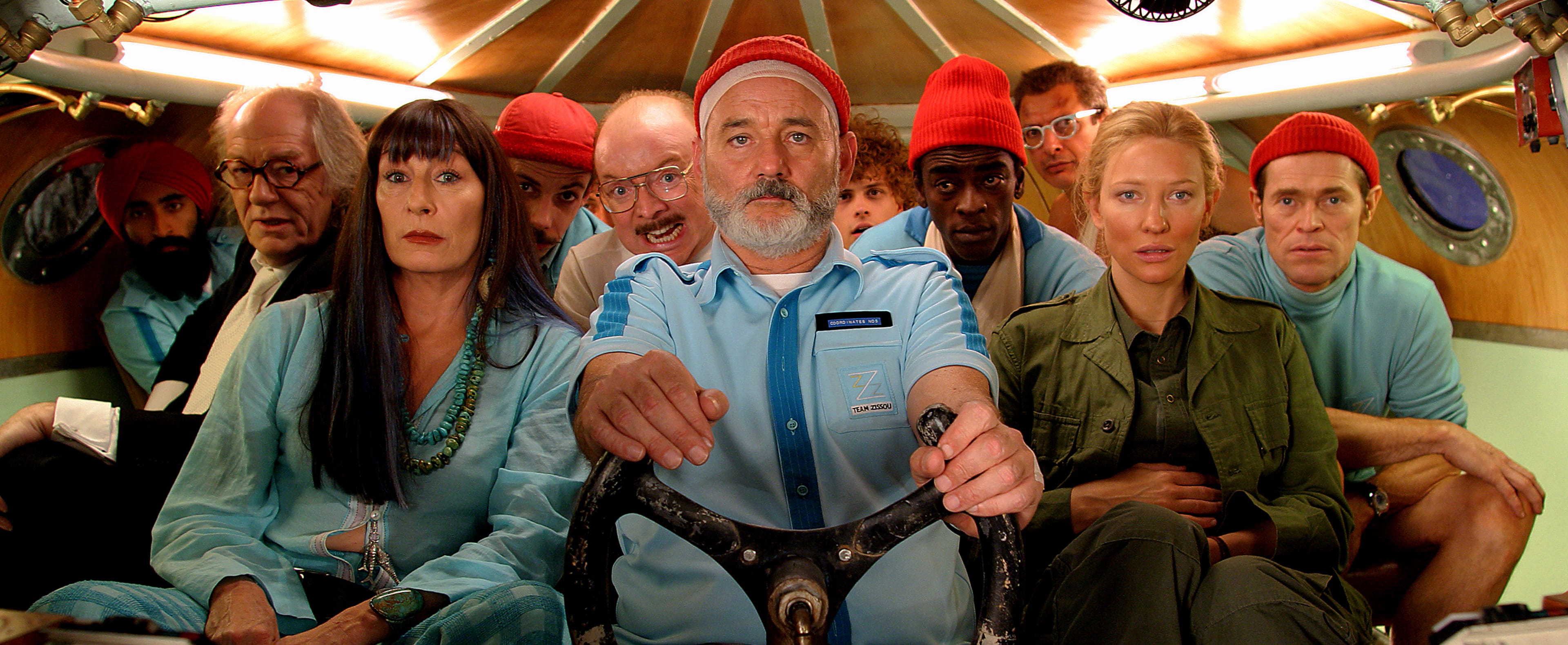
The Life Aquatic with Steve Zissou, courtesy Criterion

Interconnected stories: Wes Anderson’s films, starting with his third feature The Royal Tenenbaums, feature multiple interconnected stories with a large ensemble of popular recognizable actors.

The visual elements in Wes Anderson’s film have even led to the Accidentally Wes Anderson project, including two book collections, where photographers take pictures of real-life locations that look like they could be from a Wes Anderson film. Wes Anderson penned a forward for Vol.2 and mentioned that he had been to only 1 place highlighted in the book. Some of the locations have existed for thousands of years. That indicates the range of Wes Anderson’s influences for his films or that we have all been living in a Wes Anderson world.

Of course, Wes Anderson’s visual style wasn’t always recognizable especially in his first two films. His cinema can be broken down into three phases.

Wes Anderson 1.0: quirky comedies, fiercely independent

Films in this phase: Bottle Rocket (1996), Rushmore (1998)

Wes Anderson’s debut feature Bottle Rocket is also the acting debut of brothers Owen and Luke Wilson, a collaboration that have enriched many of Anderson’s features. Anderson co-wrote the script with Owen Wilson. The film’s visual style is more in keeping with American indie cinema of the 1990s but the quirky humour is present.

Rushmore starts the first steps towards the contemporary Wes Anderson style with Jason Schwartzman (playing the character of Max Fisher) starting his collaboration with Wes Anderson. The film contains many shots which depict collection of unique objects, as aspect that is part and parcel of his subsequent films. The story flows like a conventional film although the depiction of Max in the center of the frame is the start of Anderson’s future framing style. The humour isn’t deadpan yet but a variation of quirky.

Wes Anderson 2.0: visual style emerges along with larger ensemble

Films in this phase: The Royal Tenenbaums (2001), The Life Aquatic with Steve Zissou (2004), The Darjeeling Limited (2007), Fantastic Mr. Fox (2009), Moonrise Kingdom (2012), The Grand Budapest Hotel (2014), Isle of Dogs (2018)

The Royal Tenenbaums is the first film of what we know recognize as Wes Anderon’s style: stylish visual palette, deadpan humour, presence of interconnected stories.

The films in this phase depict a narrative arc via the lens of Wes Anderson’s style. That means, there is still focus on the story and characters while Anderson’s style enhances the material or acts as garnish. The locations still manage to shine through such as the Indian landscape in The Darjeeling Limited.

Wes Anderson 3.0: film takes place in Wes Anderson land

Films in this phase: The French Dispatch (2021), Asteroid City (2023), The Phoenician Scheme (2025)

The three features in this phase stand-out as they don't boast a coherent narrative arc. Instead, the films are a series of interconnected vignettes where the individual pieces, no matter how brilliant, don’t add up to a whole. The locations for the films don’t matter as everything takes place in a Wes Anderson designed studio, with each frame tightly controlled. These 3 films perfectly conform to the Wes Anderson style of cinema at the expense of a story or a narrative arc. As a result, the form is more important than the content. That means, the purpose of the jokes, various segments doesn’t serve the overall story but is merely there to align with the overall Wes Anderson style.

The French Dispatch is unwatchable at times, Asteroid City is only marginally better and The Phoenician Scheme shows signs of life only due to the presence of Benicio del Toro whose deadpan expressions highlight that Wes Anderson can fit any actor in his cinematic style.

Ranking Wes Anderson’s films in order of preference:

1. Fantastic Mr. Fox (2009)

A delightful film which is enhanced by Wes Anderson’s style. George Clooney’s voice truly makes the Mr. Fox character a joy to witness.

2. The Grand Budapest Hotel (2014)

Peak Wes Anderson 2.0 style. A film which showed how his style combined with a location can work wonders.

3. The Royal Tenenbaums (2001)

The first introduction to the contemporary Wes Anderson style is a charming, witty film.

4. The Isle of Dogs (2018)

Playful, fun and in a way foreshadows the chaos that the pandemic introduced in 2020.

5. The Darjeeling Limited (2012)

This film shows how actual foreign locations can work within the framework of Wes Anderson’s cinema. The bright colours of India were always going to pop but here they sing. High profile cameos are now expected in Wes Anderson’s films and this film contains one such cameo of Irrfan Khan.

6. Rushmore (1998)

7. Bottle Rocket (1996)

8. The Life Aquatic with Steve Zissou (2004)

9. The Phoenician Scheme (2025)

10. Moonrise Kingdom (2012)

11. Asteroid City (2023)

12. The French Dispatch (2021)

Essential reading

Two Adam Nayman articles perfectly describe the recent Wes Anderson cinema.

Wes Anderson’s The Phoenician Scheme Embraces the Modest Pleasures | The New Republic

Welcome Back to Wes World - The Ringer

Monday, December 22, 2014

Best Films of 2014


Like most years, my end of the year list is highly dependent on film festivals which serve as an unofficial distribution model for a majority of foreign and independent movies. However, despite the best efforts of multiple local film festivals, there is still usually an average of a 1-2 year wait to see many foreign films after its Cannes premiere. For example, a few Cannes 2013 titles only appeared in local cinemas this year. A big reason for this delay is that film distribution still follows an outdated model where films are meant to get a theatrical release first before releasing online or on DVD. This release model ignores the reality that there are only a few North American cities with dedicated arthouse/indie cinemas to give these foreign films a proper theatrical run. That means if one does not live in New York or Toronto, then it is a long wait to legally see these festival films. This delay causes a year end list to continuously look back 1-2 years for a proper assessment. For example, this year’s theatrical releases proved that 2013 was an even better year than I had first thought. A full verdict on 2014 may only be properly gauged in the summer of 2015. The other impact of this delay is that local cinemas are not my prime source for catching some of the best global films. For example, only 5 films of the 22 films (23%) in this list got a regular theatrical run in the city. A majority of this list was composed due to the 8 film festivals I attended this year, with 7 local festivals and the 8th being Sundance. 4 of the films in this list were seen at Sundance, while a 5th title, Locke, also showed there. Such a high dependence on international film festivals to catch some of the best films in the world is not a financially feasible model. And local film festivals can’t always show the top festival films every year either. Still, I am grateful to have seen many worthy features and documentaries.

Here are the top 11 films seen in 2014:

1. Locke (UK/USA, Steven Knight)


Locke uses a car and a cellphone, two items that are essential to many people’s lives, to explore moral and ethical problems related to job, family and relationships. These topics are fashioned in a manner which forces the main character Ivan Locke (Tom Hardy) to step across a moral minefield, where each step could lead to a potential explosion. The entire film takes place with Locke driving in his car and as he continues on his route, his life slowly starts to collapse. That is ironic considering his job requires him to oversee solid structural foundations. In his job, Locke is surrounded by physically heavy objects enough to crush a human. Yet, in the film, he is crushed by words. As his character of Locke sinks further, Tom Hardy as an actor soars. Hardy delivers his dialogues with a high degree of composure and emotion. His voice is so precise that it makes one forget there are cuts in the film. There is also enough variation of the shots,  which allows the camera to creatively find as much space in a confined location as possible.  Overall, this is one heck of a ride!

2. Return to Homs (Syria/Germany, Talal Derki)


Return to Homs is an embodiment of ‘Direct Cinema’, a cinematic movement which requires filmmakers to record events unfiltered and as they unfold in real time. In order to capture these raw events, Talal Derki and his crew put their lives on the line. After the Syrian revolution started in 2011, the government shut down the border to all media. Derki and his crew risked their lives to shoot this footage and in many cases, their footage is the only source of truth. As a result, this is more than just a film. It is a living breathing digital document of what happened in Syria when the world was not looking. By the time the world started looking, it was too late. The events in this film are not pleasant but since the film was completed, things have gotten worse. The events in the film are isolated to civil war but in the last few years, terrorism driven by external forces have made things worse in Syria. Return to Homs is one of the most relevant films to have been made in the last few years and is essential to understand why urban warfare is messy and complicated.

3. Enemy (Canada/Spain, Denis Villeneuve)


Enemy transports Jose Saramago’s novel The Double to a David Cronenberg landscape and enhances the material with references to Kafka, George Orwell and Alfred Hitchcock. As a result, this is a film that oozes with symbolism and is packed with delightful little clues and details which leads one through a tangled web of mystery.

4. Memphis (USA, Tim Sutton)


Tim Sutton’s Memphis is a beautiful contemplative film that depicts the fine line between genius and madness. The real coup of the film is casting Willis Earl Beal for the lead. His presence ensures that there are many moments where the film blurs the line between fiction and autobiography. The film shows a successful music artist who is in an envious position where he holds the keys to the kingdom. The problem is that the artist is no longer interested in the kingdom. Witnessing his journey as he drifts across the mystical city of Memphis, peppered with the haunting music of “Too Dry to Cry”, makes for a shattering experience.

5. Under the Skin (UK/USA/Switzerland, Jonathan Glazer)


Locke compressed life into 90 minutes while Under the Skin manages to distill the essence of men in just a few minutes. In the film, it is a woman who is behind the wheel. She cruises the streets of Glasgow looking for able men to prey on. The female is able to assess her subjects with a few glances and extract enough information with few words that allows her to make a quick decision. The sequences where she leads the victims to their final steps are remarkably filmed with an unforgettable score that stays long in the memory after the final credits.

6. Two Days, One Night (Belgium/France/Italy, Jean-Pierre and Luc Dardenne)


Even by the high standard of the Dardenne brothers, Two Days, One Night is a staggering achievement. The film depicts moral and ethical questions that are always present when money is involved. And in Marion Cotillard, the brothers have found a perfect face to convey the range of emotions from desperation to despair and even a touch of hope.

7. The Grand Budapest Hotel (USA/Germany/UK, Wes Anderson)


When the trailer for The Grand Budapest Hotel first appeared, it looked like a best of Wes Anderson reel, a collection of moments that looked new yet contained his signature. However, the trailer was only an appetizer while the film is the main course and sweet dessert rolled into one memorable experience. The film is a joy to behold, from the sets to the witty dialogue to the pleasant cameos that are sprinkled throughout the film.

8. Welcome to New York (USA, Abel Ferrara)


Welcome to New York charts the entire course of Abel Ferrara’s film style while also presenting a work that threatens to blur the line between reality and fiction. The initial 20 minutes feel like early Ferrara with exhaustive sexual exploits before the film switches gears into a vérité style that on first glance feels at odds with his cinema. However, a jail sequence reveals Ferrara’s hand where he distills the essence of his King of New York in a remarkable jail sequence. In the dialogue-less scene, Gérard Depardieu’s character of Devereaux and the other inmates assess each other, trying to determine who is the the king of the jungle. In the film’s final third, a redemption aspect crops up, without which no Ferrara film would be complete. Depardieu has put in an astonishing performance where he lays it all out in front of the camera. Even though his character faces humiliation, there are a few moments when Devereaux addresses the camera, shattering the fourth wall and tossing judgements back to the audience.

9. Li’l Quinquin (France, Bruno Dumont)


At multiple points in Li’l Quinquin, it is hard to believe that this is a Bruno Dumont directed work as his films don’t exactly invoke humor. Yet there is plenty of humor and sharp observations about French town life shown without any barriers. The film’s biggest pleasure comes from the presence of Bernard Pruvost, whose Commandant Van der Weyden is a cross between Clouseau and Tati’s Mr. Hulot. Li’l Quinquin also shows an auteur variation of True Detective.

10. Gett: The Trial of Viviane Amsalem (Israel/Germany/France, Ronit Elkabetz/Shlomi Elkabetz)


The opening minutes of the film recall A Separation but very quickly the film dives into Kafkaesque territory with endless rounds of court appearances related to a divorce proceeding. There is some humour at first but matters takes on a darker shade when the couple's private life is examined. Then gradually, everyone around the couple is sucked in and is indirectly put on trial, including the two opposing lawyers. Gett is packed with impressive performances and acute observations about how a law can impact citizens.

11. Joy of Man’s Desiring (Canada, Denis Côté)

Denis Côté is back with a visually mesmerizing and intriguing documentary that explores the factory workplace. The film starts off with some dialogue that indicates a fictional narrative but this is a documentary that examines machinery and their operators. Constantly engaging, the film is pure cinematic bliss. By a strange cosmic fate, this film premiered just a few months before Micheal Glawogger passed away. Glawogger’s Workingman’s Death shows the dangerous and messy jobs some people do to earn a living. Meanwhile, Côté spends a good deal of time showing machinery in a clean environment where workers go daily to earn money. The jobs are not as dangerous as those that Glawogger’s covers but it is clear that the machines in Côté’s film won’t tire like the humans. The workers will eventually be physically and mentally beaten down, thereby making them loosely related to those in Glawogger’s film.

11 Honorable mentions in alphabetical order:

Ankhon Dekhi (India, Rajat Kapoor)
Blue Ruin (USA/France, Jeremy Saulnier) 
Child’s Pose (Romania, Calin Peter Netzer)
Dear Albert (UK, Nick Hamer)
The Eternal Return of Antonis Paraskevas (Greece/Czech Republic, Elina Psikou)
Force Majeure (Sweden/France/Norway, Ruben Östlund)
Goodbye to Language 3D (Switzerland, Jean-Luc Godard)
Haider (India, Vishal Bhardwaj)
Lajwanti (India, Pushpendra Singh)
The Overnighters (USA, Jesse Moss)
Stray Dogs (Taiwan/France, Tsai Ming-liang)

Dear Albert is another example of ‘Direct Cinema’ as the film observes people who are trying to rid of their addiction. Nick Hamer has made an excellent decision by limiting details of the subjects’ substance abuse. This makes the film a universal study about why it is difficult for people to break their habits and change themselves. And when some manage to make a change, the film shows that it is easy to fall back into old habits. It may sound cliched but this is a film that has the potential to change one’s life.

The Eternal Return of Antonis Paraskevas is one of the best films of the New Greek Cinema Wave and is the definitive film about Greece’s economic downfall. The film uses the main character’s plight to reflect how the rest of Europe treated Greece. First there was love and admiration but when things got bad, hatred and isolation. In addition, the film is enhanced with a huge nod towards The Shining.

Pushpendra Singh’s debut feature Lajwanti (or The Honor Keeper) is an eye-popping digital painting that belongs in an art gallery along with Tsai Ming-liang’s Stray Dogs. One can clearly see the influence of Amit Dutta and Mani Kaul in Singh’s film but he has also exerted his own unique voice. In order to capture authenticity about village life in the Thar Desert (Rajasthan), Singh has used local non-actors to play themselves. This blurs the line between documentary and fiction. The story is tweaked enough to be timeless with a touch of folk mythology. It is one of the most creative films to have emerged from India this year.