The 2025 Africa Cup of Nations (AFCON) kicked off on Sun, Dec 21 and is a reminder of a time when I
did film spotlights for the different soccer tournaments (World Cup, Euros,
Copa America, AFCON). It has been almost a decade since the last such soccer
film spotlight. It was tough to do such soccer film spotlights a few decades
ago due to limited legal access to many international films. Over the last two
decades, streaming access to international films has gotten better although it
is still difficult to view films from some nations due to variety of reasons
(limited film industry/film distribution). There is where co-productions have
helped and allowed selection of a film from a country with limited film
resources.
As a means of nostalgia, here is a proposed AFCON 2025 Film
Spotlight including a Top 11 list. The only country from which I couldn’t get a
proper feature was Comoros. The island nation doesn’t have a thriving film
industry but recently, there have been a few Comoros short films shown at
international film festivals. I couldn’t get hold of these short films and
instead opted to select a documentary about Comoros.
The 24 films are listed as per the groups in AFCON 2025.
Group A: Morocco, Mali, Zambia, Comoros
Morocco: Le Grand Voyage (2004, Ismaël
Ferroukhi)
The host nation’s film selection features an emotional and
life changing journey.
In Le Grand Voyage, a father wants to undertake
a holy pilgrimage to Mecca so he asks his son to drive all the way from France
to Saudi Arabia. The son is initially not happy with his father’s decision but
gradually gains a better understanding of his father as the journey progresses.
The film manages to stand out from a traditional road feature by incorporating
some engaging elements, such as the mysterious Eastern European woman the duo
pick up. The woman’s mysterious disappearance and reappearance fits in
perfectly as does the predictable actions of the Turkish man who the son
befriends. The journey ends up becoming a metaphor for life and each experience
helps broaden the son’s mind. The end point of the journey at Mecca features
the film’s strongest and most emotional moment.
Mali: Yeelen (1987, Souleymane Cissé)
Souleymane Cissé's Yeelen beautifully
depicts an ancient Malian myth about a battle between father and son
(Nianankoro). Set in the 13th century Mali Empire, Nianankoro must tackle an
entire cult group along with his wizard father while trying to restore his
family name. The folk story is peppered with elements of magic and witchcraft
in depicting the family battle. Because Nianankoro holds the power of magic, he
is equally feared and respected.
Zambia: I Am Not a Witch (2017, Rungano Nyoni)
Rungano Nyoni’s creative debut feature is a sharp satire
about societal expectations and beliefs. The focus is Africa and witchcraft but
the core of the story is applicable to all corners of the world where women are
marginalized by one label or another.
Note: I Am Not a Witch was UK’s submission to
the Academy Awards Foreign Language category but this film is selected due to
its Zambia co-production.
Comoros: The Grand Marriage (2013, Faisal Al Otaibi)
This Al Jazeera documentary depicts the tradition of Grand
Marriage in Comoros society. The Grand Marriage is a separate event from the
actual marriage, which is a tiny affair limited to family-friends. However, the
Grand Marriage is a traditional concept undertaken to emphasize one’s standing
in society.
Group B: South Africa, Egypt, Zimbabwe, Angola
South Africa: Son of Man (2006, Mark Dornford-May)
Son of Man is a contemporary
interpretation of Jesus living in the slums and streets of Africa during a time
when gangs, religion, politics and corruption reign. Religion, politics and
corruption have caused rife for over a thousand years so in that regard,
aspects of the Biblical times are still relevant. The few contemporary changes as per the
film show how tv and radio can transmit news of miracles and tragedies faster
than ancient times. In the last two decades, smart phones and social media have
increased speed of that news transmission. The film also shows how guns are
readily available to those who need to kill people easily, an aspect that still
plagues our world today.
Egypt: Al-mummia (The Mummy/The Night of Counting the
Years, 1969, Chadi Abdel Salam)
A film that is often cited as a vital Egyptian and Arab
film. Based on real life events of tomb looting, the film raises relevant
questions about who should benefit from ancient Egyptian treasures: the locals
or a central government. Questions raised in this 1969 film still linger in our
contemporary times when tomb looting has increased in frequency.
Zimbabwe: Neria (1991, Godwin Mawuru)
This classic Zimbabwean film is based on a short-story by
award winning novelist Tsitsi Dangarembga. The story depicts the struggles of
Neria, who is widowed after the death of her husband and is left to fend for
herself and her children after her in-laws cut her out of her husband’s money.
Angola: Air Conditioner (2020, Fradique)
This refreshing new addition to Angolan cinema has a beautiful
soundtrack and lovely visuals which heighten the contemplative nature of the
film. The intriguing story has a simple entry point: air conditioners in the
capital city of Luanda have started to mysteriously fall from the buildings. A
security guard has to go about the city and find one such fallen air
conditioner for his boss who cannot withstand the city’s scorching heat. The
security guard’s journey raises relevant socio-economic questions about residents
of the city and who can afford an air conditioner.
Air Conditioner debuted at the 2020 Rotterdam
Film Festival and got lost after the world shut down in March 2020. The film did surface
and showed at other festivals once things opened up, but I imagine its
trajectory would have been different if 2020 was a regular film circuit year.
Group C: Nigeria, Tunisia, Uganda, Tanzania
Nigeria: Without Shame (2005, Lancelot Oduwa
Imasuen)
Without Shame, a Nollywood soap opera packaged
in two parts, is true to its title in depicting a father-son duo who exhibit no
morals or shame.
Steve rebels against his father's (Ben) second wife Jenny
and refuses to accept her as a mother. Steve's flirting activities bring him in
conflict with Jenny leading her to leave the house. After Jenny’s departure,
her sister Nina comes for a visit but she tries to leave when she learns that
Jenny is no longer at the house. However, Ben calmly and causally asks Nina to
stay because he does not have anyone to cook and clean the house. Things get
worse for Nina as both father and son rape her every night. When Jenny returns,
Nina is too ashamed to admit anything and continues living in the household.
The film ends with both father and son escaping from getting caught with their
pants down. Without Shame 2 extends the plot from the first
film by showing a second affair for Ben leading to three pregnancies before
everything is resolved albeit in deadly fashion.
Tunisia: Beauty and the Dogs (2017, Kaouther Ben Hania)
Based on a true story, this powerful film details the lack
of justice that exists in a corrupt society where men are allowed to abuse
their power and get away with anything. In the film, Mariam (Mariam Al Ferjani)
is a young girl who is raped by police causing her to undergo a nightmarish
Kafkaesque sequence of events. Miriam tries to report the rape but she is
unsure who to trust and is hounded by the police members who committed the
crime. She can’t even turn to her family for help as they would judge her more
harshly than the police hounding her. At times, the film is tough to view given
the never-ending psychological torture that Miriam is forced to undergo.
However, that harshness is precisely the point because no matter how hard it is
to view these scenarios, it is nowhere near as the painful struggle that women
like Miriam have to undergo.
Uganda: The Boda Boda Thieves (2016, Donald Mugisha /
James Tayler)
The film depicts the struggles of a family to make ends meet
when the father is injured and unable to bring in money. His teenage son takes
on the responsibility to earn money by driving the father’s body boda
(motorcycle). However, the young boy falls in bad company and uses the boda
boda as a means to earn quick money such as everyday purse snatching and other
local thefts. When the boda boda is stolen, the young son learns of the debt
that his family owes and he tries to make things right.
Tanzania: The Empty Grave (2024, Cece Mlay / Agnes Lisa
Wagner)
Dahomey, another entry in this AFCON film
spotlight, shows the return of African artefacts from its former colonial nation. On the
other hand, The Empty Grave is about another kind of return altogether,
something not mentioned in North American media. The film is about the return
of human remains of Tanzanians whose bodies (and head in one case) were dug up
and taken to Germany. Many Tanzanian families continue to ask Germany to return
the remains of their loves ones so they can do a proper burial/send-off and
seek closure. In many cases, the Tanzanian families have many family members
unaccounted for.
This is a highly relevant film about a topic that is
applicable not only to Tanzania but many other nations around the world where
colonists treated the bodies of the locals as prized possessions to claim and
showcase. The film also depicts lost treasures and artefacts tucked away in
Berlin but those artefacts are a subset of the story.
Group D: Senegal, DR Congo, Benin, Botswana
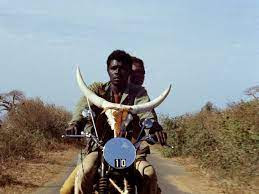
Senegal: Touki Bouki (1973, Djibril Diop Mambéty)
Djibril Diop Mambéty’s landmark film Touki
Bouki gives a good slice into an emerging African nation complete with
street shots dripping with poverty, heated arguments at the market, youths
looking for jobs and trouble, a young couple dreaming of a better future,
corruption and payback lurking around the corner with a club in hand and
unflinching slaughter shots. The relaxed lingering shots, mixed with carefully
spliced scenes give this movie a surreal feel. In addition, plenty of symbolism
in the movie with a cow's capture and slaughter being the most commonly used
symbol to echo the mental and physical entrapment of the citizens. An
incredible film that was ahead of its time.
DR Congo: Viva Riva! (2010, Djo Munga)
Viva Riva! molds elements of oil trafficking,
corruption, violence and sex into an enjoyable film. In the fashion of
Nollywood films, the villain is sinister and over the top while the hero, Riva,
is a charming intelligent man who can have any woman he wants. Of course, Riva
falls for the one woman who will lead him in trouble but Nora is too seductive
to resist. The camera ensures that Nora's beauty and Kinshasa's buzzing street
life are captured nicely.
Benin: Dahomey (2024, Mati Diop)
This highly relevant film focuses on the specific return of
26 artifacts to Benin but opens up what should be a universal debate about the
fate of looted property across Latin America, Africa and Asia. This film was
also released in 2024, the same year as the Tanzania co-production The Empty
Grave, a cosmic double billing.
Botswana: The Gods Must Be Crazy (1980, Jamie Uys)
The Gods Must be Crazy is a
humorous allegory for topics of globalization and clash of cultures, something
that has become more common place since the 1990s as Western cultural elements
starting expanding to all corners of the globe. The events are amusing but I am
not a fan of the narration, which is understanding given the film’s 1980
release. However, if the film was made in the last 2-3 decades, or from the
1920-40s, we could have enjoyed the humour without a narrator explaining every
aspect.
Group E: Algeria, Burkina Faso, Equatorial Guinea,
Sudan
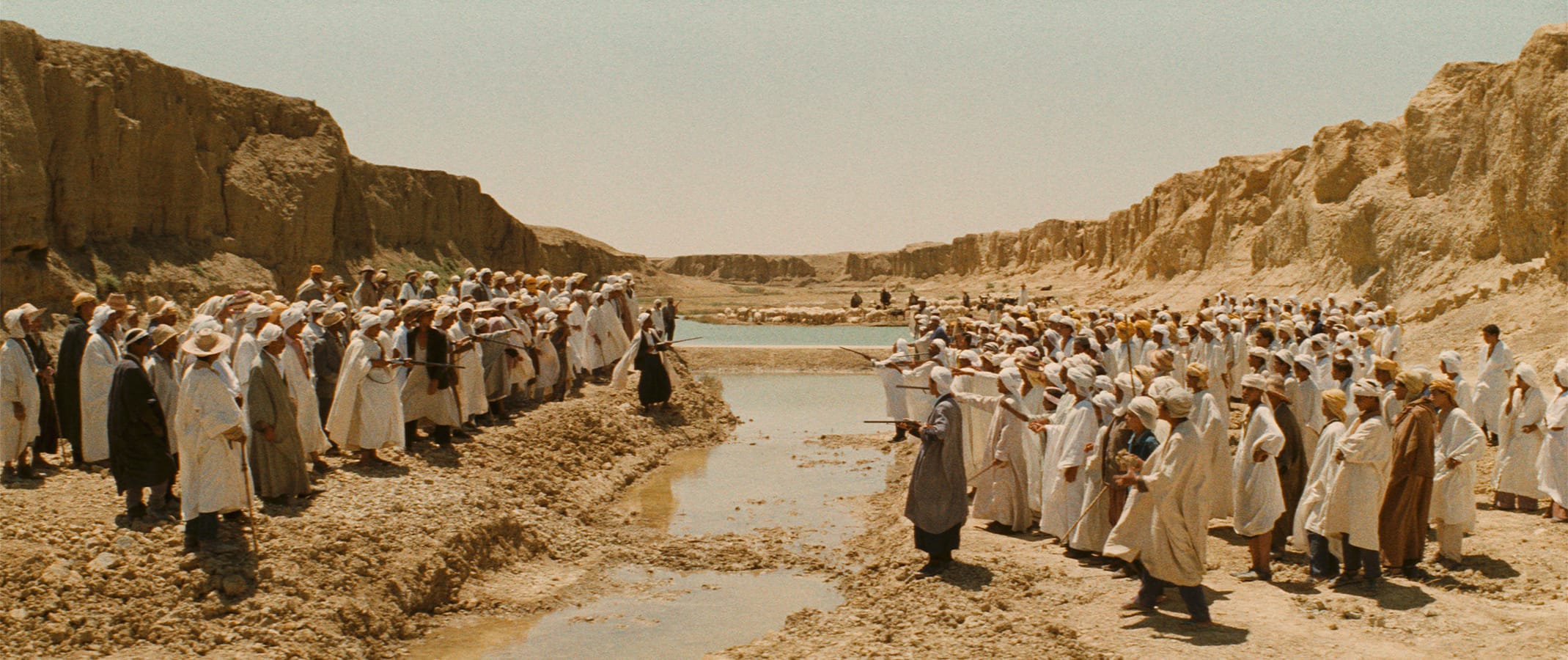
Algeria: Chronicles of the Years of Fire (1975,
Mohammed Lakhdar-Hamina)
 |
| Image courtesy: Criterion |
An epic film that is ambitious in scope and charts a timeline from WWII to
Algerian freedom. The film won the Palme d’Or at Cannes 1975 and it is easy to
see why.
The film starts off by depicting hardships of village life
made worse due to a combination of the harsh weather and lack of water (rain
coupled with a dam reducing access). This results in locals migrating from the
village to the city for a better life by leaving their land, family and roots
behind. Once in the city, the villagers are exposed to political ideas as
topics of revolution, independence and World War occupy their thoughts. The
film depicts that as WWII spreads, Algerians are forced to join France’s fight.
The locals are tired of the French, which leads to some cheering for Germany,
but they find themselves dragged into alliances and a war they want no part of.
The film’s final segments show the emergence of Algeria’s quest for
independence post-WWII and how revolutionaries are forced to hide in the
mountains to carry out their attacks against the French.
Burkina Faso: Tilaï / The Law (1990, Idrissa Ouedraogo)
The air of inevitability that hovers over Idrissa
Ouedraogo’s Tilaï is similar to that in Sissako’s Timbuktu.
The reason for the similarity is due to human’s need to maintain their honour
and traditions. The film’s alternate title ‘A Question of Honour’ emphasizes
that as well. The need to maintain this honour comes at all costs and including
killing of family as shown in the film or the taking of one’s life.
Equatorial Guinea: Where the Road Runs Out (2014, Rudolf
Buitendach)
As per the film’s title, the story is set in a house where
no paved roads lead to. After the sudden death of his friend, George (Isaach De
Bankolé) returns home to Equatorial Guinea to continue the work of his friend.
Goerge hires a taxi to take him to his friend’s house but the driver drops
George in the middle of a town square and says the address is at a location
where no cars can go. George makes his way to the house where he gets to work
and rekindles old memories of his youth. As always, Isaach De Bankolé is a
delight and he lights up the screen with his performance.
Sudan: You Will Die at Twenty (2019, Amjad Abu Alala)
An air of inevitability hangs over this lovely
contemporary feature which is a blend of myth and tradition.
Group F: Ivory Coast, Cameroon, Gabon, Mozambique
Ivory Coast: Adanggaman (2000, Roger Gnoan M’Bala)
Adanggaman blends fact and fiction in its
depiction of slavery from an African perspective in the 1600s. The film starts
off with Ossei's clash with his parents over his refusal to marry as per
tradition and their wishes. But after an attack on his village, Ossei finds
himself on the run and is eventually captured to be sold as a slave.
Cameroon: A Trip to the Country (2000, Jean-Marie
Téno)
The film's ending gives a perfect example about the infrastructural and
organizational problems in African soccer and brings to mind an incident when
in the mid 1990's the Cameroonian soccer team almost walked out of the
tournament due to a dispute about payment/bonuses. Similarly, in the ending
of A Trip to the Country a local soccer championship game is
almost disrupted due to money issues. As narrated in the film, all local teams
had to pay increased registration fees to enter the tournament whose winner
would get a trophy and prize money. However, moments before the final's
kick-off, the finalists are informed there's going to be no trophy nor any
prize money handed out. The players are not happy but are told by the officials
to play. When the game eventually starts, the players have to play on a
terrible pitch with the ball occasionally getting lost in the tall grass.
If organizational and infrastructure problems can plague the
national team, then it is not surprizing to see these problems taking place at
the root level of the game. Although such problems are not confined just to
Cameroon but inflict many other African nations as well, thereby making it hard
for an African team to mount a serious World cup challenge.
Gabon: Dôlè (2000, Imunga Ivanga)
The film’s title refers to a lottery game which promises to
make someone an instant millionaire. That allure of overnight riches is promising
to locals struggling to make ends meet, especially some of the unemployed young
boys who make a living by stealing parts from cars or whatever else they can nab.
The film starts off with their attempts to rob car wheels before giving us a
glimpse of their lives. The lottery game Dôlè enters the story in
the film’s final third and offers another chance for the boys to steal but
things don’t go as planned.
Mozambique: Mueda, Memória e Massacre (1979, Ruy Guerra)
Ruy Guerra’s docu-drama hybrid film is a recreation of the June
1960 massacre in Mueda where the Portuguese army executed 600 unarmed
inhabitants. The film shows locals re-enacting the day of the massacre but also provides
narration of events leading up to the fateful day in Mueda when locals
attempted to engage in peaceful dialogue with the Portuguese administration related
to independence and self-governance. The
Portuguese administration doesn’t take the local’s request fir dialogue well as was common
with the old colonial powers back in the day. History is packed with many
instances of colonists massacring locals and many of these incidents are lost in
time and memory as colonists omit such accounts from their historical recounts.
Top 11 AFCON 2025 Titles:
1. Touki Bouki (1973, Senegal, Djibril Diop Mambéty)
2. Chronicles of the Years of Fire (1975, Algeria,
Mohammed Lakhdar-Hamina)
3. Al-mummia (The Mummy, 1969, Egypt, Chadi Abdel Salam)
4. Le Grand Voyage (2004, Morocco co-production, Ismaël
Ferroukhi)
5. Beauty and the Dogs (2017, Tunisia co-production, Kaouther
Ben Hania)
6. You Will Die at Twenty (2019, Sudan co-production, Amjad Abu Alala)
7. I Am Not a Witch (2017, Zambia co-production, Rungano
Nyoni)
8. Dahomey (2024, Benin co-production, Mati Diop)
9. Yeelen (1987, Mali, Souleymane Cissé)
10. Tilaï / The Law (1990, Burkina Faso co-production, Idrissa
Ouedraogo)
11. The Empty Grave (2024, Tanzania co-production, Cece
Mlay / Agnes Lisa Wagner)