Béla Tarr’s Contemplative Cinema
Jan 6, 2026. Béla Tarr’s camera has stopped. No more pans,
no more movements. Tarr announced his retirement from filmmaking after the
release of The Turin Horse (2011) but I foolishly held on to the
hope that he was secretly working on another film. The news of his death puts
that hope to rest.
As a means of remembering the great Béla Tarr, I am
gathering notes on his 9 feature films and even attempting a ranking.
Note: I haven’t seen his 1982 TV movie Hamlet which
would have made this a Top 10 list.
These 9 features can be split into two distinct
stylistic and thematic phases:
Béla Tarr 1.0: Social commentary, documentary style realistic
depiction of characters / events
Films in this phase include Family Nest
(1979), The Outsider (1981), The Prefab People
(1982), Almanac of Fall (1984).
Béla Tarr 2.0: Controlled Camera movements, long takes,
minimal dialogue
Films in this phase include Damnation (1988), Satantango
(1994), Werckmeister Harmonies (2000), The Man From London
(2007), The Turin Horse (2011).
All 5 films in this phase include Tarr’s collaboration with László
Krasznahorkai. Tarr adapted 2 of Krasznahorkai’s novels (Satantango,
Werckmeister Harmonies) and Krasznahorkai wrote the screenplay
for 3 of Tarr’s features (The Man from London, The Turin
Horse and Damnation).
Ranking Béla Tarr’s films in order of preference:
1. Sátántangó (1994)

Béla Tarr’s almost 7.5 hour Sátántangó is
a cinematic wonder. The film is hypnotic and an immersive experience which
showcases the best elements of Tarr’s cinema: long takes, sweeping camera
movements, harsh realism, artistic compositions and unforgettable sounds
(howling winds, relentless rain).
2. Werckmeister Harmonies (2000, Béla Tarr / Agnes Hranitzky)
 |
| Werckmeister Harmonies: Criterion |
A town's beautiful harmonical balance is disturbed when a
mysterious circus arrives in town -- the presence of a giant whale and a
character called "the prince" causes unrest and anxiety in the town.
An evil force takes over and ordinary people riot causing havoc. The army is
called in and special "lists" are made to capture certain people.
The gorgeous rich black and white visuals combined with long takes makes for an
absorbing foray into a bizarre world crafted by Béla Tarr. Plenty of political
under-tones can be found in this film which presents a look at how people can
take advantages of certain situations and assume power. But are the ones in
power the crazy ones or the people causing the riots? In that sense, the film's
ending has shades of the Czech film Lunacy which raised
an interesting question about whether the insane people are not the ones in the
hospital but the ones in charge of running the asylum.
The beautiful music is over. Discord tunes fill the air waves. And once again,
after a long period of peace, chaos returns.
3. Damnation (1988)
 |
| Damnation: Arbelos Films |
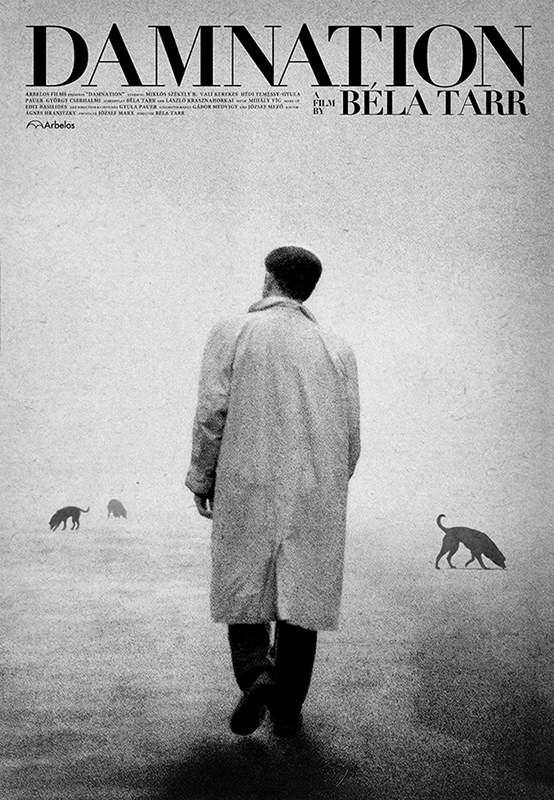
This remarkable film is the first of Tarr’s collaboration of
László Krasznahorkai and is the closest Tarr came to a film-noir. There is an
affair between a lonely man and a femme fatale, but the film has elements associated
with Tarr’s cinema: stunning black and white visuals, long takes, thoughtful
camera movements, limited dialogue, plenty of rain. And plenty of dogs. Dogs don’t
feature in Tarr’s other films as much as in this hypnotic film.
4. The Prefab People (1982)
The Prefab People starts with
infectious gypsy band music and depicts a husband walking out on his wife and
kid. She is upset at him wanting to leave just like that. As it is, he does no
work around the house and just wants to spend time with his friends, read the
paper, watch tv and drink. Eventually, the two of them patch up and go on. And
then a job opportunity in Romania comes up. That coupled with his unhappiness
is enough reason for the husband to leave again.
Although Béla Tarr's The Prefab People is
about a couple's relationship problems, it features the concept of leaving
one's home to earn a living abroad. In the movie, the husband wants to work on
a two-year contract in Romania because he will earn more money. The wife does
not want him to leave because she needs him to help with their two children.
But the husband points out that if he does not leave, then they won't be able
to afford the basic luxuries of life (car, washing machine). The husband
assures his wife that he will only go for two years and will return back.
6. Family Nest (1979)
Tarr’s debut feature is a realistic depiction of a couple’s
struggles to make ends meet including their efforts to get housing. The film’s
style is a stark contrast to Tarr’s later films. There are plenty of close-ups
and dialogue as the film feels like a documentary instead of scripted cinema.
7. The Man From London (2007)
Béla Tarr's The Man from London is a
stylish black and white film with a touch of noirish elements. The film is too
gorgeous to remove one eye's from even for a minute and the leisurely moving
camera ensures we soak up every element within the frame. The unfolding of
events in this film are in contrast to those in Werckmeister Harmonies
where the tension keeps mounting throughout the film until a chaotic climax.
However, the clock starts ticking down very early in The Man from
London towards an expected climax after a man recovers a
mysterious brief case of money.
8. The Outsider (1981)
Isolation can occur for various reasons -- society can
ignore certain members because of religion, race or whatever reason they can
come up with. Sometimes, a simple reason such a person's attitude is cause
enough for isolation. András (András Szabó), the lead character in Tarr's The
Outsider, finds himself at odds with his local Hungarian society.
András is a 20 something youngster who loves music, drifts from job to job,
does not want to be committed in a relationship. What's wrong with that?
Everything! Especially if society wants people to work for the common national
good, then one person's indifference won't be tolerated. In Tarr's Budapest,
men meet in cafes after a long day's hard work and discuss politics. If people
in a factory are too efficient, they are asked to adhere to the normal working
pace so that everyone gets paid the same. That is equivalent to asking a fast
soccer player to slow down to keep in sync with his team's slow passes. Such a
system can work for some people but for others, it is a problem. The only positive
in András' life is the love for his music which keeps him happy.
9. Almanac of Fall (Autumn Almanac, 1984)
This film focuses on the lives of tenants in an apartment
building and in contrast to Tarr’s other films, this is the only one shot in
colour. This was Tarr’s 4th feature and is stylistically different
from his next 5 features which contained controlled camera movements, long
takes and minimal dialogue.


No comments:
Post a Comment