Spotlight on the following films of Kimi Takesue:
Where Are You Taking Me? (2010)
Looking for Adventure (2013, short film 43 min)
Onlookers (2023)
Cinema is a constant discovery. The more one sees films, the
more one realizes how many more worthy films await. I hadn’t heard or read
anything about Kimi Takesue until the recent release of her films via the Criterion Channel.
This turned out to be a worthy discovery as Takesue’s unique
perspective allows a new entry point to understand travel and cultures as the
three films are set in Uganda (Where Are You Taking Me?), Peru (Looking
for Adventure) and Laos (Onlookers) respectively.
Why do you travel?
The Peruvian and Laos set films raise insightful questions about why people travel and the films break down each location into a few essentials such as common tourist attractions and places where people shop or eat. The gaze in Looking for Adventure and Onlookers is one-way only. The camera is mostly fixed in a single spot and we witness people walking on the street or standing still in the distance. Majority of the people aren’t aware of the camera, which is why they go about their activities normally. This applies equally to both local street vendors, selling food, snacks, drinks or local souvenirs, and also to tourists trying to take the same picture as others in their group.
 |
| Looking for Adventure (2013), courtesy of Kimi Takesue website |
Onlookers (2023) is more recent
while Looking for Adventure (2013) was filmed a few years after
smart phones became commonplace.
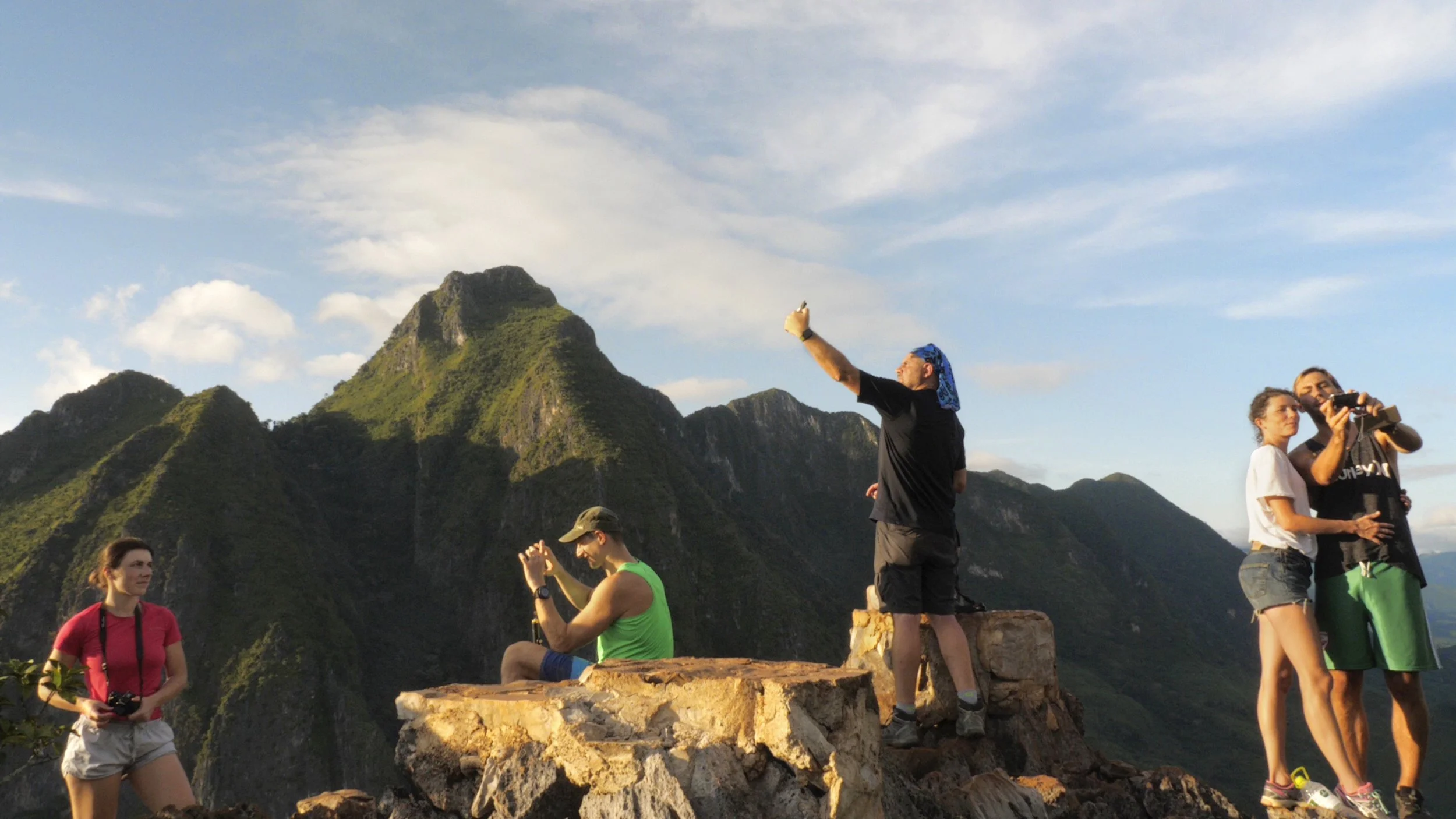 |
| Onlookers (2023), courtesy Kimi Takesue website |
Our world is packed with Instagram and social media pictures
of travelers posting the exact same picture as countless others have before
them. Everyone wants their selfie or picture of the same locations. This is
apparent in both Looking for Adventure and Onlookers.
People have different purposes of taking the pictures. For some, it is a
documentation of their travel, for others it is more about posting on social
media for others to see. There is memory and nostalgia associated with these
images. Not everyone in these movies takes images with a camera or smartphone
but many do. Given the cost of travel and how some people save money for years
to visit a place, one can’t blame their image taking.
Looking for Adventure and Onlookers
raises other brilliant contemplative questions about travel. More than the
images, why do people travel? And when they do, what do they do in the
locations? And what do they buy? Laos and Peru are on separate sides of the
world yet in both of these locations, and countless others around the world,
the interaction between locals and foreigners comes down to a few similar sale transactions:
an artistic artefact (locally made or mass-produced), jewellery, pots,
clothing, bags, postcards, photographs, magnets, small toys and dolls. Majority
of these artefacts sold could be indigenous or made by local native people
(villages or non-urban centers).
The question about why we travel may seem obvious but Kimi
Takesue’s films forces us to consider them due to her distanced observational
style. There are no talking heads or voice over narration to nudge viewers in
one specific direction nor is there apparent dialogue. We observe and can form
our own views on events.
Cultural Lens
Where Are You Taking Me? is a different film altogether from Looking for Adventure and Onlookers and those differences are what makes Where Are You Taking Me? not as strong as the other two. Where Are You Taking Me? focuses on events around Kampala, from the streets to sporting events to documenting about civil war survivors. The film showcases Uganda and documents the country for others to see. There aren’t any tourists visiting the location and we don’t get to see the exchange of two cultures. However, the film’s title makes sense later on as the directors tells curious kids watching the camera where the film will be shown (US). That admission by the director ensures this film isn’t a one-way gaze and opens up a two-way mirror into us seeing the locals and on the same hand, the locals being aware of those on the other side of the planet.
 |
| Where Are You Taking Me? (2010), courtesy of Kimi Takesue website |

